
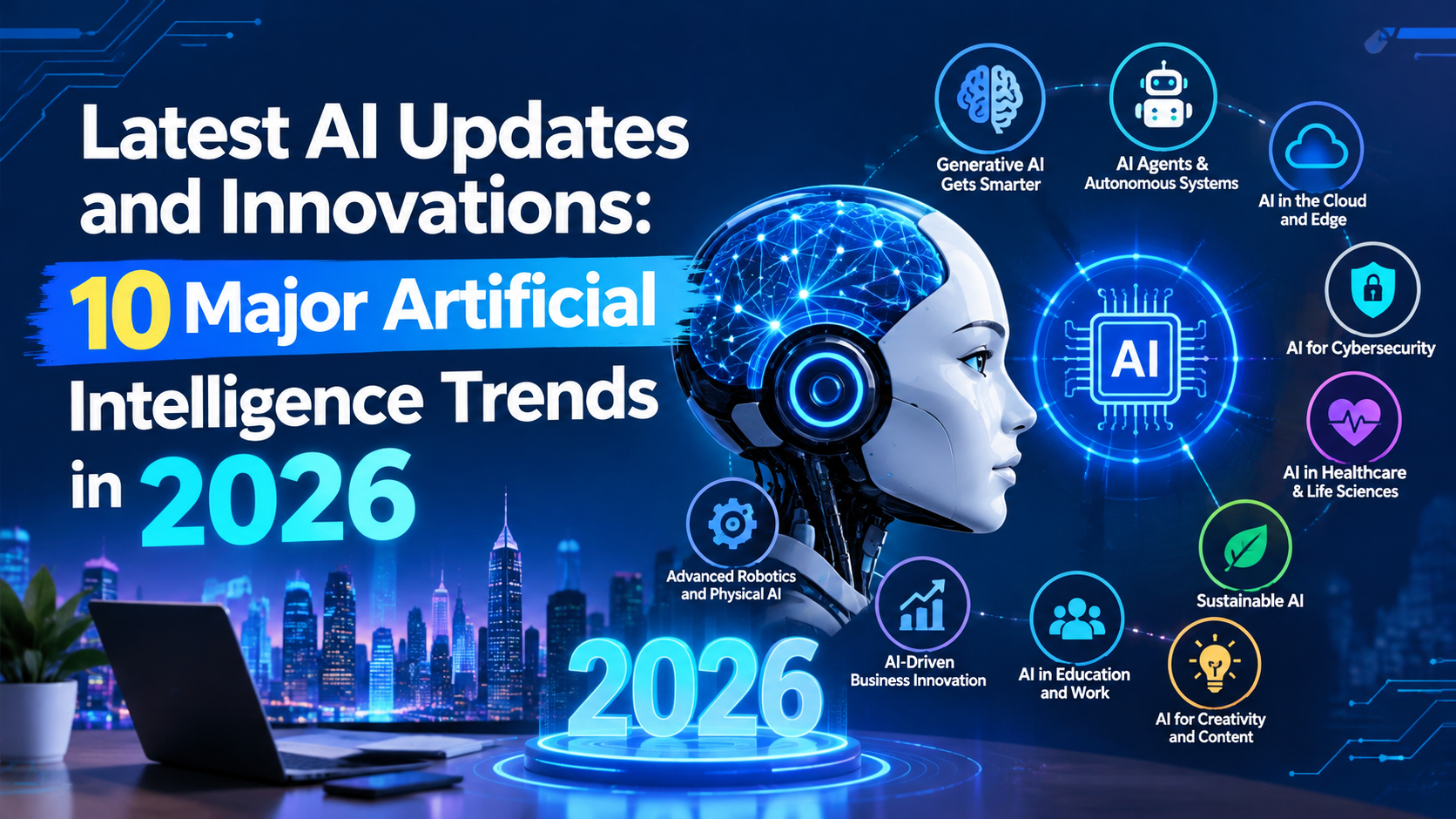
Explore the latest AI updates and innovations in 2026, including AI agents, generative AI, robotics, multimodal models, healthcare applications, and future technology trends.
Artificial Intelligence (AI) has become one of the most influential technologies in the modern world. From virtual assistants and automated customer support to advanced research systems and intelligent robots, AI is changing how people work, learn, communicate, and solve problems. Businesses, educational institutions, healthcare organizations, and technology companies are increasingly adopting AI to improve efficiency and develop innovative solutions.
The latest AI updates and innovations in 2026 demonstrate a significant shift from simple chatbots toward more capable systems that can understand different types of information, perform complex tasks, support scientific research, and interact with digital tools. AI is no longer limited to answering questions or generating text. New developments are helping AI systems plan activities, analyze information, assist developers, and complete selected tasks with human supervision.
Major technology companies are investing in advanced AI models, autonomous agents, robotics, and responsible AI development. These innovations are creating opportunities for businesses and individuals while also raising important questions about privacy, security, accuracy, and employment.
In this article, we explore 10 important AI updates and innovations in 2026, their practical applications, benefits, challenges, and potential impact on the future.
1. AI Agents Are Transforming Everyday Work
One of the most important developments in artificial intelligence is the growing use of AI agents. Traditional AI assistants mainly respond to questions or follow individual instructions. AI agents are designed to work toward a specific goal by planning steps, using digital tools, and completing tasks within defined permissions.
For example, an AI agent may help a business research competitors, organize information, prepare a report, summarize emails, or assist with software development. Depending on its capabilities and permissions, it may also interact with connected applications.
In October 2026, Google Cloud introduced its Gemini agent for work, reflecting the growing competition to develop AI systems that can assist with tasks across applications. Other companies are also exploring agents that can manage longer-running responsibilities and coordinate different activities.
Benefits of AI Agents
- Improved productivity: AI agents can help reduce the time spent on repetitive activities.
- Task automation: They can support routine administrative and operational work.
- Better organization: Agents can help manage information, projects, and workflows.
- Business efficiency: Organizations can use agents to assist with research, documentation, and customer service.
However, AI agents should not be given unlimited access to sensitive systems. Human approval, activity monitoring, access restrictions, and clear instructions remain essential, especially when an agent can send messages, modify files, or perform financial or administrative actions.
2. Generative AI Continues to Advance
Generative AI is another major area of innovation. This technology can create new content, including articles, images, videos, music, presentations, and computer code, based on user instructions and learned patterns.
Earlier generative AI tools were often used for basic writing and image creation. Modern systems are expanding into more sophisticated tasks, such as producing structured reports, helping with research, editing multimedia content, and assisting with complex programming challenges.
Businesses can use generative AI to prepare marketing materials, create product descriptions, develop training resources, and generate ideas for new campaigns. Students may use it to understand difficult subjects, create revision notes, and practice problem-solving.
Content creators can also use generative AI to develop outlines, explore design concepts, and produce drafts more efficiently.
Important Applications of Generative AI
Content creation: AI can help prepare articles, summaries, advertisements, and social media posts.
Image and video generation: Creators can generate visual concepts and support multimedia production.
Software development: Coding assistants can suggest functions, explain errors, and help developers understand unfamiliar code.
Business communication: AI can assist with emails, presentations, reports, and customer responses.
Despite these benefits, generated content should be reviewed carefully. AI systems may produce incorrect facts, biased statements, misleading images, or code containing security vulnerabilities. Human judgment remains necessary to ensure quality and reliability.
3. Multimodal AI Is Making Technology More Interactive
Multimodal AI refers to systems that can process or generate more than one type of information. Depending on the model, this may include text, images, audio, video, and other structured inputs.
For example, a user may upload an image and ask an AI system to explain what it shows. Another user might provide a document and a voice instruction, asking the system to summarize the document and explain its key points.
These capabilities make AI more flexible because people can communicate using the information available to them instead of relying only on written prompts.
Google’s 2026 AI announcements have included work on models that combine different input types and support more interactive experiences. The wider technology industry is also exploring systems that understand video, generate speech, and combine visual information with reasoning.
Where Multimodal AI Can Be Useful
- Education: Students can ask questions about diagrams, charts, and textbook images.
- Healthcare support: Authorized professionals can use AI tools to assist with selected image and document analysis.
- Customer service: Systems can process text, voice, and visual information to help resolve customer questions.
- Accessibility: Speech and image capabilities can help users interact with digital information in different ways.
- Creative work: Designers can combine written instructions with visual references to develop new concepts.
Multimodal systems are not automatically accurate simply because they can process several formats. Users should verify important interpretations, especially when decisions involve health, finance, safety, or legal matters.
4. AI Is Supporting Healthcare and Medical Research
Healthcare is one of the most promising areas for artificial intelligence. Researchers and healthcare organizations are exploring AI to help analyze medical information, support scientific discovery, improve administrative workflows, and identify patterns in large datasets.
AI tools can assist researchers in reviewing scientific literature, organizing clinical information, and exploring potential relationships between biological factors. In selected settings, specialized systems can also support medical imaging analysis and help professionals prioritize cases for further examination.
Recent AI research and technology developments have also focused on biological modeling and drug discovery. These applications may help scientists investigate complex biological processes and identify promising directions for additional experiments.
Key Uses of AI in Healthcare
Medical imaging: Specialized AI systems can assist trained professionals in reviewing certain scans and identifying areas that require attention.
Drug discovery: AI can help researchers investigate molecules, predict properties, and prioritize candidates for laboratory testing.
Healthcare administration: Automated tools can assist with appointment scheduling, documentation, and information management.
Personalized research: AI can help scientists analyze large datasets to explore differences between patients and biological processes.
Public health: Data-analysis systems can support research into disease patterns and healthcare needs.
However, AI is not a replacement for qualified medical professionals. Medical information may be incomplete or inaccurate, and healthcare decisions require clinical judgment, appropriate testing, and consideration of individual circumstances. Patient privacy and secure handling of medical records are also essential.
5. AI-Powered Robotics Is Becoming More Advanced
Robotics is another field benefiting from advances in artificial intelligence. Traditional robots often operate according to carefully programmed instructions. AI-powered robots can increasingly use sensors, visual information, and learned models to interpret their surroundings and respond to changing conditions.
This development is helping researchers explore robots that can assist with manufacturing, warehouse operations, logistics, research, and certain household activities.
AI-powered robotics combines several technologies, including machine learning, computer vision, motion planning, and sensor processing. Together, these systems can help robots recognize objects, navigate environments, and perform selected physical tasks.
Examples of AI Robotics Applications
Manufacturing: Robots can assist with assembly, inspection, and repetitive production activities.
Warehousing: Intelligent robotic systems can help move inventory and organize goods.
Agriculture: AI-powered machines can support crop monitoring, targeted spraying, and selected harvesting activities.
Healthcare environments: Robots can assist with logistics and other carefully defined tasks in suitable settings.
Research and exploration: Autonomous systems can help investigate environments that are difficult or dangerous for humans to access.
Despite continued progress, robots still face challenges involving unpredictable environments, physical safety, cost, reliability, and complex manipulation. Human supervision and appropriate safety mechanisms remain important when robots operate near people.
6. AI Is Changing Software Development
Software development is experiencing significant changes as AI coding assistants become more capable. Developers can use these tools to generate code suggestions, explain programming concepts, identify possible bugs, write tests, and document existing projects.
More advanced systems can help with multi-step development workflows, such as examining a codebase, proposing changes, and assisting with debugging. Some agent-based tools can also work with development environments and related applications under defined permissions.
These capabilities can benefit both experienced programmers and beginners who are learning languages such as Python, JavaScript, Java, and SQL.
How AI Helps Developers
- Faster coding: AI can generate initial implementations for common programming tasks.
- Debugging assistance: Developers can ask for explanations of errors and potential solutions.
- Learning support: Beginners can request examples and explanations of unfamiliar concepts.
- Testing: AI can suggest test cases and help identify missing scenarios.
- Documentation: Developers can use AI to create explanations of functions, APIs, and project structures.
Nevertheless, AI-generated code must be reviewed and tested before it is used in production. Incorrect assumptions, insecure code, outdated libraries, and hidden defects can create serious problems.
Developers who understand programming fundamentals, databases, security, testing, and system design will remain better equipped to evaluate AI suggestions and build reliable applications.
7. AI Is Creating New Opportunities in Education
Education is becoming more personalized through the use of AI-powered learning tools. These systems can explain concepts, generate practice questions, summarize learning materials, and help students identify areas that require further study.
For example, a student learning mathematics can request a step-by-step explanation of a problem. Someone preparing for a competitive examination can use AI to generate quizzes and organize a revision schedule.
Teachers can also use AI to create lesson outlines, prepare classroom activities, and adapt learning resources for different ability levels.
Benefits of AI in Education
Personalized learning: Students can explore subjects at their own pace.
Instant explanations: AI tools can clarify difficult concepts and provide additional examples.
Study planning: Learners can create schedules based on subjects, deadlines, and examination dates.
Language support: AI can help users practice writing, grammar, translation, and vocabulary.
Teacher assistance: Educators can use AI to draft educational materials and administrative documents.
However, students should avoid depending entirely on AI-generated answers. AI tools may misunderstand questions, provide incorrect information, or produce inaccurate references. Copying generated work without understanding it can also weaken learning.
The most effective approach is to use AI as a learning assistant while continuing to practice independent thinking, research, writing, and problem-solving.
8. AI Is Improving Data Analysis and Business Decisions
Modern businesses generate large amounts of information through sales, customer interactions, websites, financial systems, and operational activities. AI can help organizations analyze this information and identify patterns that might otherwise be difficult to detect.
AI-powered analytics tools can summarize datasets, assist with forecasting, categorize customer feedback, and help managers explore possible explanations for changes in performance.
For example, an online retailer might analyze customer purchasing patterns to improve inventory planning. A marketing team could examine campaign performance and identify which messages receive more engagement.
Business Applications of AI Analytics
- Customer insights: Identify common preferences and recurring customer concerns.
- Sales forecasting: Estimate future demand using historical data and suitable models.
- Inventory management: Help businesses plan stock levels and reduce waste.
- Marketing optimization: Analyze campaign results and support audience segmentation.
- Risk analysis: Identify unusual patterns that may require further investigation.
AI-generated recommendations should not be treated as guaranteed predictions. The quality of the results depends on data accuracy, model limitations, changing market conditions, and the assumptions used in the analysis.
Businesses should also ensure that data is collected and processed lawfully, with suitable safeguards for customer and employee information.
9. AI Safety, Privacy, and Responsible Development Are Gaining Importance
As AI systems become more capable, responsible development is increasingly important. AI can create significant benefits, but it can also introduce risks involving misinformation, privacy violations, cybersecurity, discrimination, and unexpected automated actions.
For example, an AI-generated image may be mistaken for a real photograph. A chatbot might provide a confident but incorrect answer. An AI agent with excessive permissions might change or share information in an unintended way.
These risks make testing, monitoring, transparency, and appropriate human oversight essential parts of AI adoption.
Important AI Safety Practices
Protect personal information: Avoid sharing confidential business records, passwords, financial details, or sensitive personal information with tools that are not approved for such use.
Verify important claims: Check facts against trustworthy sources, especially when dealing with health, finance, education, or legal matters.
Review automated actions: Require confirmation before an AI system performs consequential or difficult-to-reverse tasks.
Test systems regularly: Evaluate accuracy, security, reliability, and performance under realistic conditions.
Monitor bias: Check whether an AI system produces unfair results for particular groups or situations.
Be transparent: Clearly identify AI-generated or AI-assisted content when disclosure is appropriate or required.
Responsible AI does not mean stopping innovation. It means developing and using AI in ways that improve its usefulness while reducing foreseeable harm.
10. AI Skills Are Becoming Valuable for Future Careers
AI is changing the skills employers need across many industries. Rather than affecting only software engineers, AI is becoming relevant to marketing, customer support, finance, education, design, administration, and data analysis.
Employees who understand how to use AI tools responsibly may be able to complete certain tasks more efficiently and focus on work requiring communication, creativity, judgment, and problem-solving.
For students and job seekers, learning practical AI skills can be a useful addition to existing qualifications.
AI Skills Worth Learning in 2026
AI tool usage: Learn to write clear instructions and evaluate AI-generated results.
Prompt writing: Practice giving specific context, constraints, examples, and expected output formats.
Data analysis: Develop skills in spreadsheets, SQL, visualization, and interpreting data.
Programming fundamentals: Learn how applications work and how to test and debug code.
AI-assisted content creation: Understand how to use AI for research, drafting, editing, and brainstorming.
Cybersecurity and privacy: Learn to protect information and recognize common digital risks.
Critical thinking: Practice checking claims, identifying assumptions, and making independent decisions.
AI will not affect every occupation in the same way. Some tasks may become automated, while other jobs may change or emerge. Learning continuously and combining technical knowledge with human skills can help people adapt to this evolving environment.
Additional AI Innovations to Watch
Beyond these 10 major developments, several other areas deserve attention.
AI for Scientific Discovery
Researchers are using AI to help investigate complex scientific questions, analyze experimental data, and explore possible solutions in fields such as biology, chemistry, and climate science. These systems can help generate hypotheses, but experimental validation remains necessary.
Smaller and More Efficient AI Models
Not every task requires the largest available AI model. Smaller, specialized models can sometimes provide lower costs, faster responses, and more practical deployment on local devices or within private systems.
AI-Powered Voice Experiences
Voice-enabled AI is becoming more interactive, allowing users to speak naturally with digital assistants. Such systems can help with language practice, accessibility, customer support, and hands-free interaction.
AI for Weather and Environmental Research
AI models are increasingly being explored for weather prediction, environmental monitoring, and analysis of complex climate-related datasets. Their usefulness depends on the quality of the data, the specific forecasting task, and validation against established methods.
These areas illustrate that AI innovation is not limited to chatbots. It also includes scientific research, physical systems, specialized software, and technologies that help people understand the world.
Challenges Facing the AI Industry
Despite rapid progress, several challenges may influence how quickly AI is adopted.
1. Accuracy and Reliability
AI systems can produce convincing but incorrect information. Organizations need appropriate testing, independent verification, and clear procedures for handling mistakes.
2. Data Privacy
Many AI applications rely on information provided by users or organizations. Protecting sensitive data and controlling access are essential for maintaining trust.
3. Cost and Infrastructure
Training and operating advanced AI systems can require significant computing resources, electricity, and specialized infrastructure. Efficient models and responsible resource management are therefore important.
4. Employment Changes
Automation may reduce the need for certain repetitive tasks while increasing demand for other skills. Workers and employers may need to invest in training, reskilling, and redesigned workflows.
5. Copyright and Intellectual Property
AI-generated content can raise questions about ownership, permitted use, attribution, and the material used to train models. Users should understand the rules that apply to their tools and jurisdictions.
6. Security and Misuse
AI may be used to create deceptive content, support scams, or assist malicious activities. Technical safeguards, security testing, public awareness, and appropriate governance are necessary to reduce these risks.
How Individuals and Businesses Can Prepare for the Future of AI
Preparing for AI does not necessarily require advanced technical knowledge or a large budget. Individuals and organizations can start with manageable steps.
- Identify practical needs: Choose tasks where AI may save time or improve quality.
- Start with small experiments: Test AI tools on low-risk activities before using them for important work.
- Develop relevant skills: Learn prompt writing, data literacy, digital security, and AI evaluation.
- Verify the output: Check facts, calculations, citations, and generated code.
- Protect confidential information: Use approved tools and follow data protection policies.
- Measure results: Compare time, quality, cost, and error rates before and after introducing AI.
- Keep learning: Follow official product announcements, technical documentation, and credible research publications.
The goal should not be to use AI for every activity. Instead, people should identify where it genuinely improves results and where human judgment remains more appropriate.
Sources
https://openai.com/news/research/
https://deepmind.google/research/
Conclusion
The latest AI updates and innovations in 2026 show that artificial intelligence is moving beyond basic question-and-answer tools toward more interactive, capable, and task-oriented systems. AI agents, generative AI, multimodal models, robotics, healthcare research, software development, and personalized education are among the important areas shaping this transformation.
These technologies offer opportunities to improve productivity, support scientific discovery, simplify routine work, and create new products and services. At the same time, challenges involving accuracy, privacy, cybersecurity, employment, and responsible use must be addressed.
For students, professionals, and businesses, understanding AI is becoming an important part of preparing for the future. Learning relevant skills, verifying AI-generated information, and using technology responsibly can help people benefit from these developments.
Artificial intelligence is likely to continue evolving, but its long-term value will depend not only on how powerful the technology becomes, but also on how thoughtfully people develop and use it.
FAQs
1. What are the latest AI updates and innovations in 2026?
Important developments include AI agents that perform multi-step tasks, generative AI tools, multimodal models, AI-powered robotics, healthcare research applications, and more advanced coding assistants. Their availability and capabilities vary by product and region.
2. How is AI changing businesses?
AI can help businesses automate repetitive work, analyze data, support customers, create content, assist with software development, and improve operational planning. Human review is still important for important business decisions.
3. Will AI replace human jobs in the future?
AI may automate some tasks and change how certain jobs are performed, but its impact will vary by industry and occupation. Workers can prepare by developing technical knowledge, communication skills, creativity, critical thinking, and the ability to work effectively with AI tools.
4. Is artificial intelligence safe to use?
AI can be useful when applied appropriately, but it is not always accurate or reliable. Users should protect sensitive information, verify important answers, review automated actions, and avoid relying on AI alone for high-stakes decisions.
5. How can beginners learn about AI in 2026?
Beginners can start by exploring accessible AI tools, learning basic prompt writing, studying machine learning concepts, practicing data analysis, and taking introductory courses. Building small projects and checking information against reliable sources can help develop practical skills.