
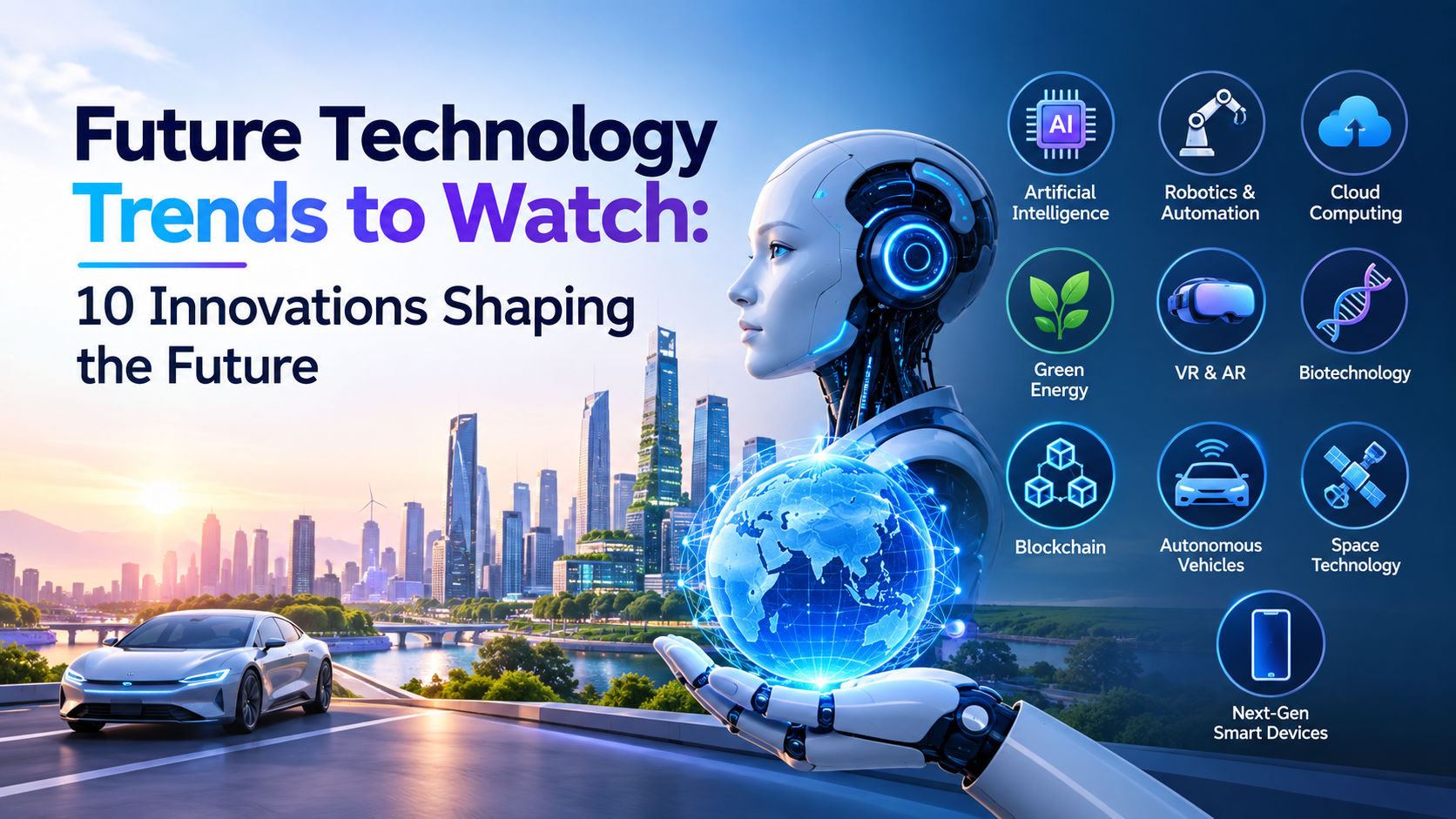
Discover the future technology trends to watch, including AI, robotics, quantum computing, spatial computing, cybersecurity, biotechnology and next-generation energy.
Technology is changing faster than ever before. From artificial intelligence and robotics to quantum computing, smart devices, clean energy and advanced cybersecurity, new technologies are transforming the way people live, work and communicate. Businesses, governments, schools and individuals are increasingly adopting digital solutions to improve productivity, reduce costs and solve complex problems.
As we move further into 2026 and beyond, technology is becoming more connected. Instead of one technology developing independently, several technologies are now working together. For example, artificial intelligence can be combined with robotics, advanced sensors, quantum computing, biotechnology and energy systems to create completely new solutions.
The World Economic Forum’s 2026 technology research highlights this growing convergence across areas such as artificial intelligence, robotics, spatial intelligence, quantum technology, advanced materials, engineering biology and next-generation energy.
For students, professionals, entrepreneurs and businesses, understanding these developments can help them prepare for the future. Here are some of the most important future technology trends to watch.
1. Artificial Intelligence and AI Agents
Artificial intelligence is one of the biggest technology trends of the modern era. AI is already being used in search engines, chatbots, customer service, healthcare, education, programming, marketing and business operations.
However, the next phase of AI is expected to go beyond simple question-and-answer systems. AI agents are being developed to complete tasks, coordinate workflows and interact with different software tools with less human intervention.
For example, instead of simply asking an AI system to write an email, a future AI agent could potentially understand a business goal, collect information, prepare the email, organize supporting documents and request human approval before sending it.
IBM’s 2026 technology outlook highlights the movement of AI from a basic tool toward systems that can assist with complex engineering and IT workflows.
Why AI matters
AI can help businesses:
- Automate repetitive tasks
- Analyze large amounts of data
- Improve customer support
- Generate content
- Assist software development
- Detect patterns and problems
- Support business decision-making
The growing use of AI also means that workers will need new skills. Understanding how to use AI responsibly may become as important as traditional computer skills.
2. Physical AI and Advanced Robotics
Robotics is moving beyond traditional industrial machines. Modern robots are increasingly being designed to understand their surroundings, process information and respond to changing environments.
This development is often described as physical AI. It combines artificial intelligence with cameras, sensors, robotics and real-world interaction.
Future robots could become more useful in warehouses, factories, healthcare facilities, agriculture, transportation and homes.
For example, robots may assist with warehouse operations, inspect industrial equipment or perform repetitive manufacturing tasks. In healthcare, robotics combined with AI and advanced sensing is already being explored for more precise procedures and improved workflows.
The major challenge is making robots reliable and safe when they operate in unpredictable environments.
3. Quantum Computing
Quantum computing is another important technology to watch.
Traditional computers process information using bits, while quantum computers use quantum bits, commonly called qubits. Quantum computing uses principles of quantum mechanics to approach certain complex problems in fundamentally different ways.
Quantum computers are still developing, but researchers and companies are exploring applications in areas such as:
- Drug discovery
- Materials science
- Financial optimization
- Cryptography
- Scientific simulations
- Complex optimization problems
The World Economic Forum’s 2026 emerging technology report specifically identifies quantum simulation for drug discovery as an important developing area.
Quantum computing is unlikely to replace ordinary computers for everyday tasks. Instead, its potential lies in solving particular problems that are extremely difficult for classical computing systems.
4. Spatial Computing and Digital Twins
Spatial computing is another technology area that could change how people interact with digital information.
It combines technologies such as artificial intelligence, sensors, computer vision, augmented reality, virtual reality and 3D environments to help computers understand physical spaces.
One important application is the digital twin.
A digital twin is a virtual representation of a real object, building, machine or system. Companies can use digital twins to monitor performance, simulate changes and identify potential problems.
For example, a manufacturer could create a digital model of a production line and test a change virtually before making the change in the real factory.
This can potentially reduce costs, improve planning and minimize operational risks.
Spatial intelligence is also becoming increasingly connected with AI and robotics. The World Economic Forum identifies spatial intelligence as one of the major technology domains contributing to technological convergence.
5. Next-Generation Energy Technology
Technology is not only changing computers and software. Energy systems are also undergoing major innovation.
The growing demand for electricity from data centers, electric vehicles, smart devices and industrial systems is creating new challenges for energy infrastructure.
Emerging technologies are focusing on better batteries, smarter grids, renewable energy integration and more efficient energy storage.
The World Economic Forum’s 2026 emerging technologies report highlights everything-to-grid energy, where buildings, vehicles and other distributed energy resources can potentially store and return electricity to the grid when required.
Electric vehicles could therefore become more than transportation devices. In the future, their batteries may also become part of larger energy systems.
Better energy technology could help support:
- Electric vehicles
- Renewable energy
- Smart homes
- Data centers
- Industrial systems
- Energy storage
- Grid resilience
6. Advanced Cybersecurity and Post-Quantum Cryptography
As technology becomes more connected, cybersecurity becomes increasingly important.
Businesses and individuals store huge amounts of sensitive information digitally, including financial information, personal data, business records and communication.
Quantum computing also creates a future cybersecurity challenge because sufficiently capable quantum computers could threaten some existing encryption methods.
One technology being developed to address this challenge is post-quantum cryptography.
The World Economic Forum identifies lattice-based cryptography as a major emerging technology because it is designed to protect information against both classical and future quantum attacks.
Organizations will increasingly need to think about cybersecurity as a long-term process rather than a one-time investment.
Future cybersecurity systems may include:
- AI-powered threat detection
- Stronger encryption
- Zero-trust security
- Automated monitoring
- Identity protection
- Post-quantum cryptography
7. AI-Powered Healthcare and Personalized Medicine
Healthcare is another field where technology is expected to make significant progress.
Artificial intelligence can analyze medical information, assist researchers and help identify patterns in large datasets. At the same time, advances in biotechnology are creating opportunities for more personalized approaches to treatment.
The World Economic Forum’s 2026 emerging technology report highlights personalized mRNA cancer vaccines and quantum simulation for drug discovery among technologies moving toward real-world applications.
In the future, healthcare could become increasingly personalized based on a patient’s specific biological information.
Technology may help researchers:
- Discover potential drug candidates
- Analyze biological data
- Develop personalized treatments
- Improve medical imaging
- Support clinical research
- Monitor health conditions
However, healthcare technology will also require strong privacy, safety, testing and regulatory standards.
8. World Models and Smarter AI
A newer direction in artificial intelligence is the development of world models.
Traditional AI systems can recognize patterns in text, images or other data. World models aim to go further by building an internal representation of how the physical world works.
This could be particularly useful for robotics, autonomous systems and simulation.
For example, a robot operating in a warehouse needs to understand objects, movement, space and cause-and-effect relationships. A world model could help an AI system predict what might happen after an action.
The World Economic Forum describes world models as AI systems designed to understand and predict physical-world behavior using information from multiple sources such as video, sensors and text.
This technology could eventually support more capable robots, autonomous vehicles and advanced simulations.
9. Biotechnology and Engineering Biology
Biotechnology is increasingly combining with artificial intelligence, automation and advanced computing.
Engineering biology involves designing or modifying biological systems for useful purposes. Applications can include healthcare, agriculture, materials and industrial production.
AI can help researchers analyze biological information and identify promising possibilities more quickly.
The convergence of AI and biology may support developments such as:
- New medicines
- Personalized healthcare
- Sustainable materials
- Improved agricultural systems
- Biological manufacturing
- Faster scientific research
The World Economic Forum identifies engineering biology as one of the major technology domains contributing to the broader convergence of technologies.
10. Technology Convergence
Perhaps the most important future trend is not one individual technology but the combination of multiple technologies.
For example:
AI + Robotics = Intelligent Robots
AI + Healthcare + Biotechnology = Personalized Medicine
AI + Digital Twins + Robotics = Smart Manufacturing
Quantum Computing + Biology = Advanced Drug Discovery
AI + Energy Systems = Smarter Electricity Networks
This type of technology convergence is becoming increasingly important. The World Economic Forum’s 2026 Technology Convergence Report explains that major opportunities are emerging from combinations of AI, robotics, spatial intelligence, quantum technology, advanced materials, engineering biology and next-generation energy.
This means the future may not be defined by a single revolutionary invention. Instead, progress could come from connecting different technologies together.
How These Future Technologies Could Change Everyday Life
Future technology will influence more than businesses and research laboratories. It could gradually become part of everyday life.
Smart homes may become better at managing electricity consumption. AI assistants could help people organize tasks and information. Electric vehicles could interact with energy grids. Healthcare systems may use more personalized data. Robots may assist with certain household or workplace activities.
Education could also change significantly. AI-powered learning platforms can provide personalized explanations and practice activities based on a student’s needs.
Workplaces may increasingly use AI agents and automation for repetitive activities, allowing employees to focus more on creative, analytical and interpersonal responsibilities.
However, technology adoption will not happen equally everywhere. Cost, infrastructure, digital skills, regulations, privacy and access to reliable internet and electricity will all influence how quickly different technologies become widespread.
Skills People Should Develop for the Future
As technology evolves, learning one specific software tool may not be enough. People should focus on skills that remain useful across changing technologies.
Some valuable future-oriented skills include:
1. AI Literacy
People should understand what AI can and cannot do, how to use AI tools and how to verify AI-generated information.
2. Data Skills
Basic knowledge of data analysis, spreadsheets, databases and data visualization can be useful across many careers.
3. Cybersecurity Awareness
Understanding passwords, phishing, privacy, authentication and safe online behavior is increasingly important.
4. Programming
Programming remains valuable because software continues to power many emerging technologies. Languages such as Python, JavaScript and SQL can provide useful foundations.
5. Critical Thinking
AI can generate answers quickly, but people still need to evaluate accuracy, context and reliability.
6. Adaptability
Technology changes quickly. The ability to learn new tools and adapt to new working methods can be more valuable than knowing one particular tool permanently.
Challenges Associated With Future Technology
Future technology brings opportunities, but it also creates challenges.
Privacy
AI systems often depend on large amounts of data. Protecting personal information will remain an important concern.
Cybersecurity
More connected systems can create more potential entry points for cyberattacks.
Employment Changes
Automation may change the tasks performed by workers in many industries. Some jobs may be redesigned while new roles emerge.
Digital Divide
People and regions with limited access to technology may not benefit equally from technological progress.
Regulation
Governments and organizations will need rules for responsible use of AI, biotechnology, robotics and other emerging technologies.
Energy Consumption
AI systems and large data centers require substantial computing infrastructure and energy. As AI adoption grows, efficient computing and new energy solutions will become increasingly important. The World Economic Forum has highlighted the growing convergence between energy and computing infrastructure.
Why Businesses Need to Follow Technology Trends
Businesses that understand emerging technologies can better prepare for changes in their industries.
Companies do not necessarily need to adopt every new technology immediately. Instead, they can identify which developments are relevant to their customers, employees and operations.
For example, a manufacturing company may investigate robotics and digital twins, while a financial company may focus on AI, cybersecurity and quantum-resistant encryption.
Small businesses can also benefit from technologies such as AI-powered customer service, automation, cloud computing and data analytics.
The key is to focus on practical problems rather than adopting technology simply because it is new.
Future Technology Trends to Watch in the Coming Years
Several technology areas deserve continued attention:
- Artificial intelligence and AI agents
- Physical AI and robotics
- Quantum computing
- Spatial computing
- Digital twins
- Next-generation energy systems
- Advanced cybersecurity
- Post-quantum cryptography
- Personalized biotechnology
- World models
- Advanced materials
- Technology convergence
Some of these technologies are already being used commercially, while others are still developing. Their adoption speed will depend on technical progress, cost, infrastructure, regulation and public acceptance.
Sources
World Economic Forum – Top 10 Emerging Technologies of 2026
IBM – The trends that will shape AI and tech in 2026
Conclusion
The future of technology is likely to be defined by rapid innovation and increasing connections between different technological fields. Artificial intelligence, robotics, quantum computing, spatial intelligence, biotechnology, cybersecurity and next-generation energy are all developing at the same time.
One of the biggest changes is the growing convergence between these technologies. AI can support robotics, quantum computing can contribute to scientific research, digital twins can improve industrial systems and advanced energy technologies can support the growing demand for computing.
For students and professionals, the best preparation is to keep learning. Developing digital skills, AI literacy, data knowledge, cybersecurity awareness, programming ability and critical thinking can help people adapt as technology changes.
The future is not simply about machines becoming more advanced. It is also about how people, businesses and societies use these technologies responsibly to solve real-world problems. By understanding the major future technology trends to watch, individuals and organizations can better prepare for the opportunities and challenges ahead.
FAQs
1. What are the biggest future technology trends to watch?
Some major trends include artificial intelligence, AI agents, robotics, quantum computing, spatial computing, digital twins, advanced cybersecurity, biotechnology and next-generation energy systems.
2. Will AI replace human jobs in the future?
AI is expected to automate or change some tasks, but its overall effect will vary by industry and occupation. At the same time, new roles and responsibilities can emerge around AI development, management, cybersecurity, data and human-AI collaboration.
3. What is quantum computing used for?
Quantum computing is being researched for complex problems such as drug discovery, molecular simulation, optimization, materials science and cryptography. It is not designed to replace ordinary computers for everyday activities.
4. Why is cybersecurity important for future technology?
As more devices, businesses and services become connected, protecting data and digital systems becomes increasingly important. Future cybersecurity will also need to prepare for potential threats from advanced quantum computers.
5. What skills should students learn for future technology careers?
Students can benefit from learning AI tools, programming, data analysis, cybersecurity basics, problem-solving, communication and critical thinking. Continuous learning is especially important because technology changes rapidly.